
Making Sense of Monad Liquid Staking
Dieser Artikel ist auf Englisch veröffentlicht.
Network Review5 Min.November 25th, 2025

Monad - Introduction
After more than two years of development, the highly anticipated Monad mainnet officially launched on the 24th of November, 2025. For H2O Nodes, this marks one of our most anticipated chain launches. This report will explore the key features and evolving Liquid Staking Protocol (LSP) ecosystem of this new Layer-1 blockchain.
Monad is a next-generation EVM-compatible Layer 1 blockchain designed to address the scalability and performance challenges faced by existing chains like Ethereum. It achieves this by implementing optimizations across five key areas:
- MonadBFT: High-performance and fork-resistant Byzantine Fault Tolerant consensus.
- RaptorCast: Enables efficient block propagation.
- Asynchronous execution that pipelines consensus and transaction processing to extend execution time.
- Parallel execution combined with just-in-time compilation for rapid transaction handling.
- MonadDb: Specialized database designed for efficient state access.
These characteristics make Monad an Ethereum-compatible blockchain capable of processing 10,000 transactions per second (TPS), with a block time of approximately 400 milliseconds and transaction finality of about 800 milliseconds. This significantly increases throughput and reduces latency compared to Ethereum, while maintaining compatibility with Ethereum's tools and smart contracts.
Founders
Monad was founded by Eunice Giarte, Keone Hon and James Hunsaker in early 2022, with the objective of scaling a highly decentralized system through the implementation of a novel software architecture. Eunice Giarte has previous experience in derivatives trading, working as an analyst at the Bank of America and also as a Senior Product Manager at Shutterstock. Keone Hon and James Hunsaker have both worked in leadership roles in high-frequency trading at Jump Trading. Founded in 1999, Jump Trading specializes in algorithmic and high-frequency trading strategies. Jump Crypto, established in 2021, serves as the dedicated blockchain and cryptocurrency division, focusing on both trading and building key infrastructure for decentralized ecosystems, such as the Firedancer client for Solana. (Will Jump build another client for Monad, one day?)
Investors
In just over one year, Monad raised an impressive $244 million, making it one of the most highly-funded L1 projects. Among the investors are:
Paradigm: Led the $225 million Series A in 2024 with an investment of $150 million, which valued Monad at $3 billion. Paradigm is known for backing Ethereum protocols like Uniswap and Optimism, and is involved in the development and maintenance of crypto infrastructure such as Reth, an efficient Ethereum execution client, and Tempo, a new L1 for stablecoin payments developed in collaboration with Stripe.
Dragonfly Capital: Led the $19M seed round in 2023, describing Monad as an “exciting project that will have the level of throughput needed for wide-scale adoption of decentralized finance.”
Other investors include Electric Capital, Coinbase Ventures, Greenoaks, Castle Island Ventures, Animoca Ventures, CoinFund and Finality. Notable angel investors include Ansem, Hsaka, Punk6529, Eric Wall, Rune Christensen, Bryan Pellegrino, Luca Netz and Mert Mumtaz.
In May 2024, OKX Ventures became involved with Monad through a strategic investment, thereby consolidating the latter's position in Asia and among exchanges.
Monad Foundation & Category Labs
The Monad Foundation was established in early 2025 under the leadership of Keone Hon and Eunice Giarta. The organisation is founded on the principle of independence, with a commitment to the growth and decentralization of the Monad blockchain protocol. At the same time Monad Labs was renamed as Category Labs. The organisation will continue to allocate resources to the research and development of the technology that underpins the Monad protocol client. Category Labs comprises more than 40 engineers and researchers.
More than 300 projects are already building or running on Monad’s testnet. The ecosystem includes both native builders and multichain protocols that have integrated Monad, such as 0x, Chainlink, Uniswap and others.
Mentionable protocols building on Monad include:
- YieldApp by Accountable: a yield marketplace.
- Curvance: Curvance wants to make DeFi lending more effective. It does this by improving how borrowers and lenders interact in areas like collateral, liquidity, and returns.
- Ambient: (formerly CrocSwap), a DEX that supports two-sided AMMs combining concentrated and ambient constant-product liquidity on any arbitrary asset pairs.
Other noteworthy protocols include Townsquare (Lending Protocol), Kuru (DEX) or Lumiterrra (Gaming).
Testnet metrics
The purpose of testnet was to subject the protocol to a stress test, while enabling developers to safely build and test apps, and engaging the community. It achieved the following metrics:
4.5 billion total transactions, with the highest daily amount reaching close to 200 million.

The peak in the number of daily active accounts was around 10 million, with a total of almost 320 million total active accounts.

The highest number of TPS, including both successful and failed transactions, was recorded in November 2024 at around 10,000 TPS.
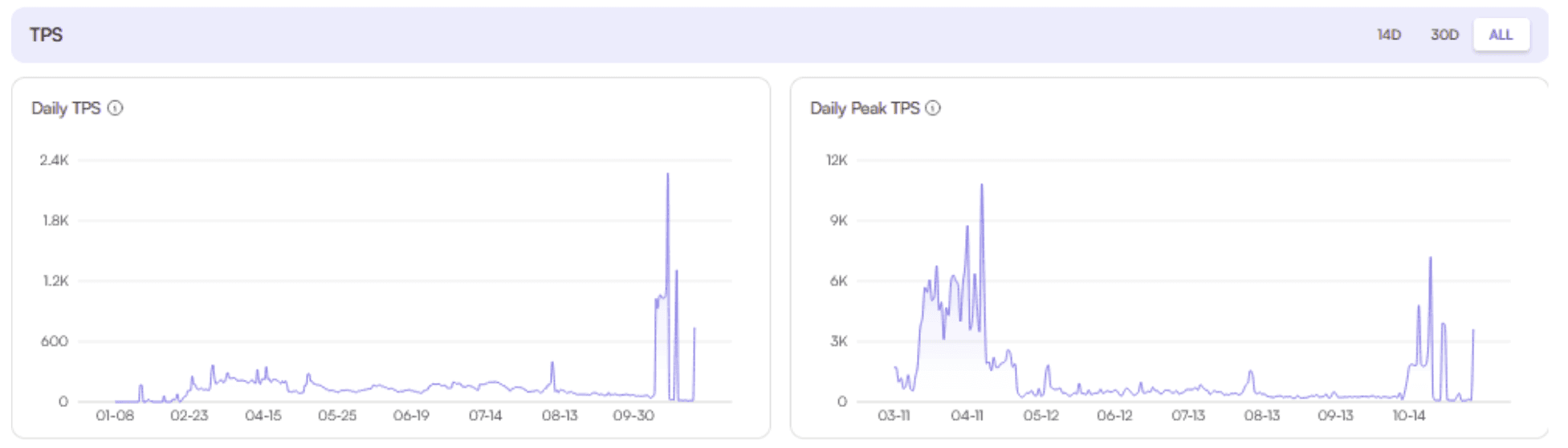
Although the testnet provides solid metrics for evaluating the protocol’s stress limits, true adoption can only be measured on the mainnet, where real transactions and economic activity occur.
Tokenomics
At launch, MON will have a total supply of 100B tokens, with 49.4B MON (49.4%) unlocked. The supply of MON will change over time due to inflation and deflation. Inflation comes from block rewards and deflation comes from burning transaction fees. Validators earn 25 MON per block, which equals about 2B MON per year or a 2% annual inflation rate. Around 10.8B MON (10.8%) will be distributed through the token sale and the MON Airdrop. About 38.5B MON (38.5%) will support ecosystem growth, and 27% will go to the Monad team. The remaining tokens are unlocked until the end of 2029.

Token sale
Monad is the first protocol that conducted a token sale on Coinbase. 7.5% percent of the total token supply (100B MON) was reserved for the public sale. The price per token was $0.025 with the total funds raised through the token sale calculated at $216M, hitting 115% of the target.
Monad Staking Mechanics
Staking Behavior
Staking is used to determine “the voting weights and leader schedule in MonadBFT.” It makes the network more secure by increasing the cost of achieving a superminority (1/3) or supermajority (2/3), which makes it harder to halt the network or to make an incorrect outcome permanent. The staking system is accessed via the stateful staking precompile, which allows both delegators and validators to carry out actions such as registering a new validator, delegating or undelegating, and handling rewards (claiming and compounding).
- Minimum self-stake (100,000 MON): For validators a minimum amount of self-delegated stake is required, they can also benefit from delegated stake.
- Minimum stake (10M MON): Additionally, validators must have a minimum stake to be part of the active validator set (200).
- Block reward: When a new block is created, the responsible validator receives a block reward, that is shared among the validator’s delegators, proportional to their share of the validator’s total stake, after deducting the validator’s commission. The amount of the reward for each block is 25 MON.
- Validator commission: Validators can charge a commission between 0% and 100%. This represents their fixed percentage of the block reward.
- Rewards for successful block proposer: Fixed reward from inflation plus priority fees from all the transactions in the block.
To unstake the MON token a period of 1 epoch (50,000 blocks; 5.5 hours) is required.
Automated slashing might be implemented in the future, but the details aren't clear yet.
It is important for users to note that any changes to the stake weight can only be made at epoch boundaries. However, it is possible to delegate or undelegate the stake at any time.
Liquid Staking
Introduction
In traditional staking the user “locks” (stakes) e.g. ETH or MON to receive staking rewards. In Proof of Stake protocols, users who stake their tokens provide crucial support for the decentralization and security of the network. Locked assets are used to achieve consensus. This is necessary to secure the network and ensure the validity of every new transaction written to the blockchain.
Traditional staking has the drawback of locking up assets, restricting users from utilizing them for other means. Liquid staking provides a remedy for this problem as it addresses illiquidity by converting locked capital into tradable assets. With liquid staking, the stake position becomes "liquid," as stakers receive a receipt token for their deposit, which serves as proof of ownership for the staked asset. The receipt token is liquid on the secondary markets and can be used as collateral in DeFi.
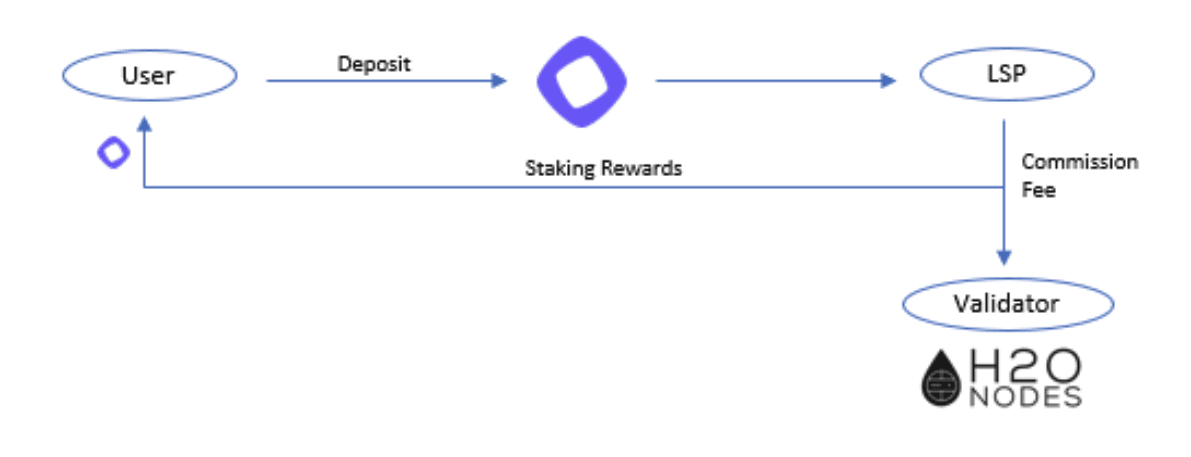
While liquid staking presents many opportunities, it is not risk-free. Liquidity risk stems from the fact that the receipt token trades independently on the market. In bearish market conditions or during a liquidity rush, LSTs can trade at a discount compared to the underlying token because of limited liquidity from the staked token (e.g. MON) as users try to exit their positions. Additional risks include custody and smart contract risks, which can vary depending on whether a decentralized or centralized provider is utilized.
Monad Liquid Staking
Similarly to Ethereum, liquid staking is present on Monad. This section briefly analyzes the characteristics and benefits of liquid staking on Monad.
- Liquidity and Utility: Users receive liquid staking tokens (LSTs) that can be traded, collateralized, or used in DeFi protocols without unbinding from staking rewards.
- Security and Decentralization: Staked tokens are delegated across multiple validators, improving average uptime and performance.
- Enhanced Rewards through MEV: Protocols like aPriori, Fastlane or Magma incorporate Maximal Extractable Value (MEV) strategies, allowing users to earn additional rewards beyond standard staking yields by participating in transaction ordering and arbitrage activities.
- Integration and Composability: Improving liquidity and utility by enabling staked assets to interact with DeFi, lending, and collateral systems, making the staking assets more versatile.
Overall, liquid staking has the potential to boost liquidity, unlock greater capital efficiency, and strengthen network decentralization and security. Monad's infrastructure facilitates composable applications, thereby enabling the seamless utilization of staked assets across a range of lending, borrowing, and liquidity provisioning protocols.
Monad LSP Landscape
There are already a number of LSPs built on top of Monad. This section provides an overview of the current solutions, their differences, adoption and MEV solutions. The current LSPs are Fastlane, aPriori, Kintsu and Magma. All the protocols could attract attention in their testnet phase as the statistics below show.

LSTs will compete with each other and other DeFi protocols to offer yield to users and attract stake.
Kintsu
Kintsu’s edge is decentralized governance. By building the first liquid staking protocol on Monad engineered as a public good, Kintsu maximizes capital efficiency by unifying liquidity and network security. Kintsu is defined as a composable liquid staking protocol to enhance the “GDP of DeFi”. Kintsu’s LST is called sMON. Last year, the protocol raised a $4 million seed round, with the investment being led by Castle Island Ventures. Kintsu was founded by Stephen Novenstern who previously worked as Head of Strategy at Pangolin (DEX on Avalanche). Pangolin achieved over $16 billion in trading volume and is live across more than five networks with over 3,200 trading pairs. Unlike legacy LSTs that rely on static, curated validator sets, Kintsu gives the DAO full control over how stake is delegated among validators, a model that’s all fueled by the $KSU token. This turns liquid staking into a credibly neutral coordination layer that aligns validators, builders, and users around network growth.
On Ethereum, concerns around the centralization of Lido’s staking pool and DAO governance likely contributed to its failure to expand beyond 33% market share, a critical level for proof of stake systems. Kintsu aims to design a fairer, more decentralized approach, aligning the growth of their staking pool with increasing robustness and decentralization of the overall Monad network, allowing them to capture the majority of the staking market.
Fastlane
Fastlane Labs was co-founded in 2022 by Jordan Hagan and Alex Watts, who brings experience as Head of Software Engineering at Halter and as an Enterprise Solutions Architect at AWS. In March 2025 Fastlane Labs raised $6 million in funding led by Figment Capital to build a LST on Monad. The underlying LST of the protocol is called shMonad (shMON). “shMONAD introduces a modular and policy-driven approach that allows for siloed bonding and enhanced yield management”, describes Fastlane’s documentation.
Atlas by Fastlane
The Atlas framework Atlas developed by Fastlane permits protocols to keep the MEV created within their ecosystem. Atlas is a simple solution for protocols “to retain as much of the value as they generate as possible.” The functionality of this system is facilitated through auctioning off of the right to execute a transaction immediately subsequent to a user's. These two transactions are then consolidated into a single atomic transaction. Often dApps are forced to rely on centralized entities, such as blockbuilders for RPC-based MEV Protection services. In certain cases, these services even require legal agreements between multiple parties. The Fastlane MEV Protection system employs the functionality of smart contracts to regulate the auction mechanism by utilizing the Atlas Protocol. It demonstrated that there is no requirement for bundles or the correct "transaction ordering". The MEV is captured inside the aforementioned one atomic transaction.
Gained revenue from auctions can be used in multiple useful ways:
- Buy and burn of the governance token
- Discount for users
- Redistribution to liquidity providers (compensation for impermanent loss)
Productive MEV
- Integrates with FastLane on Monad node software (MFL)
- Works in conjunction with Atlas EVM for MEV optimization
- Internalizes and refines MEV into new yield streams
- Benefits both Monad applications and validators
Some of FastLane's technology is being added to Monad by the Category Labs team. The fastlane-monad-bft code functionality is merged into the main monad-bft client. This means that the FastLane MEV protocol can operate without a custom client. In addition, a new getter will let on-chain contracts identify the current validator. For shMonad, this is important because it allows MEV revenue to be attributed and LST stake allocation to validators to become fully permissionless. This means that whitelists and team-managed mapping won't be needed.
Monad MEV Research Group (MMRG)
FastLane set up the Monad MEV Research Group (MMRG), a group of validators, protocols, applications, and MEV researchers working together to study MEV on the Monad Testnet. The group works together to develop MEV practices, which allows FastLane to test and improve MEV solutions with input from key stakeholders across the Monad ecosystem.
Magma
Magma is a community-powered LSP on Monad, in which community members are able to engage in decision-making processes and align with the long-term direction of the protocol. Users can stake MON into a pool in exchange for 1:1 gMON LST, which is then utilized in DeFi. In the first phase of Magma MON is delegated to a group of whitelisted node operators and depositors receive staking rewards and additional APY from MEV. The second phase will involve moving liquidity to nodes using DV.
At the end of October 2025, Magma raised $3.9M in a seed round, with participation from Bloccelerate, Animoca Ventures, CMS Holdings, Maelstrom, and angel investors including Meltem Demirors, Kartik Talwar, Mike Silagadze, Alan Curtis and Ben Lakoff. Magma was founded by David Mass and Meir Bank, who previously worked at Citibank and AngelDAO. Magma is developed by Hydrogen Labs, a company that focuses on LST and MEV development.
In addition, Magma unveiled gVaults, a pioneering staking vault innovation on Monad. It empowers users to select particular validators for staking while preserving fungibility for their liquid staking token, gMON. The protocol limits risk through the implementation of validator whitelisting (selected by Magma) and deposit caps (0.25% of total assets of Magma), thereby ensuring that losses from slashing are safely socialized, if slashing is implemented on Monad. Validators are provided with customized deposit portals, and institutions are now able to meet both compliance and operational requirements within the staking process on Monad.
Magma also partnered with Obol Collective to explore Distributed Validators (DVs) on the Monad blockchain, aiming to improve security, decentralization, and slashing resilience for its staking protocol. This will enable multiple operators to jointly run single validators, boosting network reliability and inclusivity through Obol's distributed validator middleware expanding the decentralized operator ecosystem within Monad.
MEV Solution
The gMON LST of Magma is characterized by the presence of MEV-boosted yield, which is powered by Magma’s block engine. This block engine encompasses the provision of transaction simulation and reverts protection, thereby ensuring maximum profitability for both validators, searchers and gMON holders. The transaction simulation (checking the probability of passing and failure of the transactions before executing) can achieve multiple benefits for validators and stakers. These include preventing failed transactions, optimising block space and selecting the most profitable bundles.
The block engine speed is a crucial factor in the optimization of arbitrage strategies by searchers within the limited time window allocated for each slot on Monad. Monad validators take part in the Magma auction. There, they sell blockspace and generate MEV rewards. These are then shared with stakers, boosting their APY.
Stages
- 1st stage: Searcher API: Searches (that are actively searching for profit opportunities in transactions e.g. arbitrage) send bundles to the block engine.
- 2nd stage: Block engine: processing and simulation of bundles to provide revert protection.
- 3rd stage: validator sidecar: receive the bundles from the block engine and include them in blocks produced by the validator.
The aim is to minimize latency and intermediary steps in the MEV process, a crucial aspect of Monad, given the limited time available to searchers to submit bundles (less than half a second). The Magma MEV process contains a significantly reduced number of intermediaries when compared to the Ethereum MEV process, and its design bears a closer resemblance to that of Jito on Solana.
aPriori
aPriori is a MEV-powered liquid staking platform. It is designed to enhance validator incentives, improve capital efficiency, and foster a more decentralised and scalable blockchain environment. The platform received support from backers including Pantera Capital, Binance Labs, Consensus, OKX Ventures, and Everstake Capital, with funding rounds totalling $30 million and an expected valuation of over $250 million. Founded by Ray Song and Olivia Z., the testnet attracted over one million unique addresses, indicating early adoption. Olivia Z.’s professional background includes senior software engineering roles at Coinbase and as an investment associate at Bridgewater Associates. Ray Song was a core contributor to the Pyth network and held previous roles at Flow Traders and Jump Crypto. APriori is currently the most prominent LSP on Monad. It was the first to introduce its own protocol token (APR), which got listed on Coinbase. The LST of the protocol is aprMON.
By leveraging Monad's parallel EVM and high-throughput environment, aPriori's architecture is intended to deliver enhanced scalability and performance for growing user demand. Moreover, aPriori developed its LST to facilitate interoperability with DeFi applications across the Monad ecosystem. This improves liquidity and provides more ways for users to use their staked assets.
aPriori's objective is to optimize the order of transactions in order to maximize the value earned from staking. This is achieved by combining MEV (Maximal Extractable Value) strategies with liquid staking. aPriori's infrastructure is designed to address the issue of MEV profit monopolization by large validators. This allows smaller participants to benefit and thereby improves decentralization. Technically, this is achieved by creating a marketplace that intelligently sequences transactions while minimizing adverse externalities such as front-running and spam attacks.
Conclusion
The launch of Monad goes along with high expectations for scalable, high-performance blockchain infrastructure. The evolving liquid staking landscape on Monad shows already the protocol’s potential to drive innovation and adoption.
With Fastlane’s modular LST framework, aPriori’s focus on interoperability, Kintsu’s community-led governance, and Magma’s MEV-based yield strategies, the LSP ecosystem on Monad is already well-developed and positioned to compete with other Layer 1 networks. It remains to be seen whether one of the LSPs will gain majority market share, or whether they will compete with each other dynamically going forward.
About H2O Nodes
Founded in 2022, H2O supports blockchain networks with decentralized infrastructure, ecosystem building, and strategic investment. Supported protocols include Ethereum, Solana, Sui and more, combining more than $350 million in staked assets. H2O is a trusted provider for institutional players such as Lido, Marinade and Fortuna Custody.
Author: Jonathan Beyer
Disclosure: H2O has invested in aPriori, Fastlane, and Kintsu.